Wugongshan: The Two-Day Grass Plateau Hike in Jiangxi
Most Chinese mountains are about rock and temples. Wugongshan is about grass. Above roughly 1,600 m the trees stop, and for kilometre after kilometre you walk a rolling plateau of alpine meadow that looks closer to the Scottish Highlands than to anything you expect in Jiangxi. In autumn the whole ridge turns gold, and on the right morning you are walking above a sea of cloud with the summits poking through it.
It is also one of the most accessible big walks in China: high-speed rail to Pingxiang, an hour by road, and then you are on the plateau. No permit, no guide, no expedition logistics. That combination has made it the classic Chinese weekend trek, so expect company on the ridge in October.
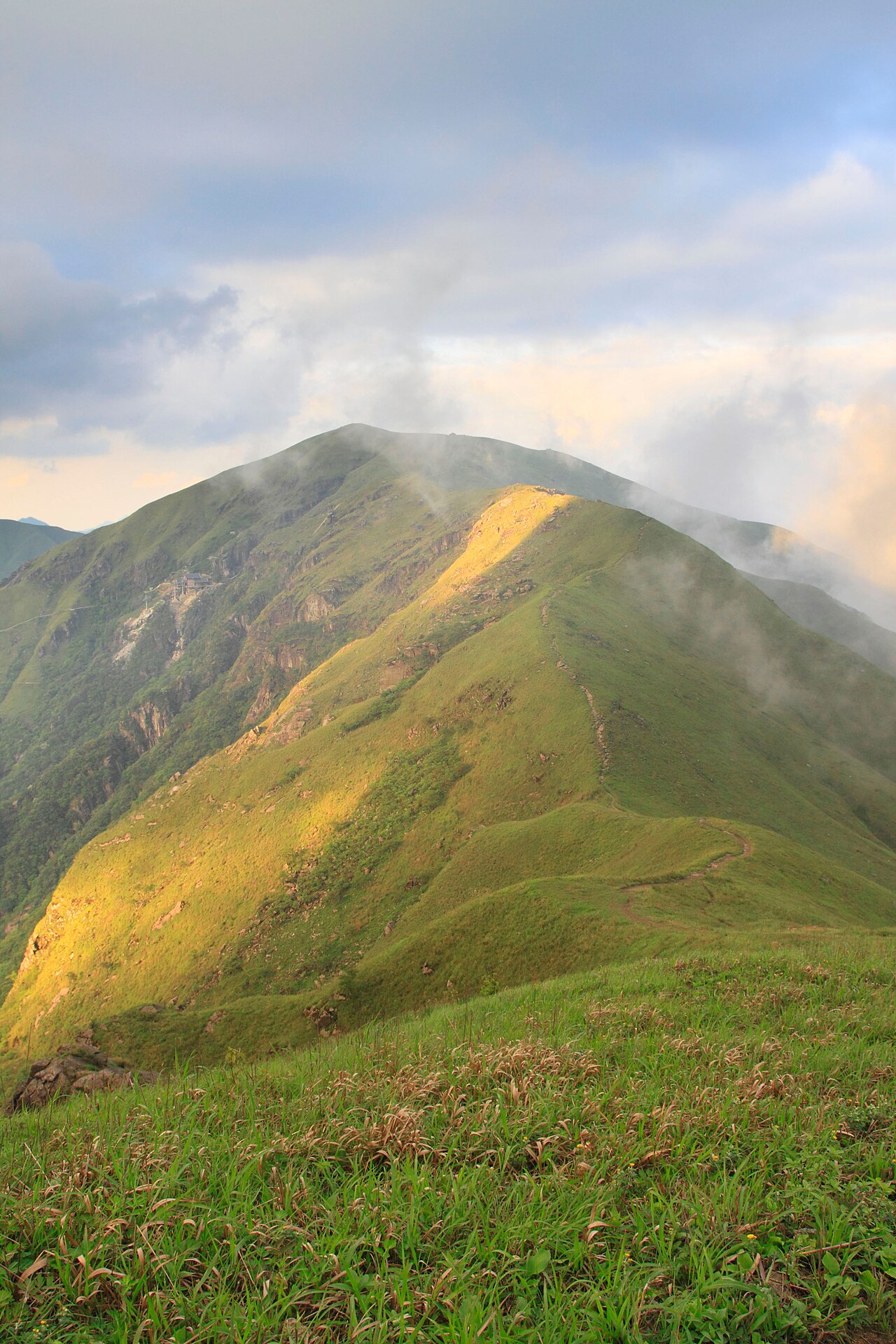
Photo: Doctoroftcm / Wikimedia Commons, CC BY-SA 3.0
Wugongshan at a glance
| Detail | What to expect |
|---|---|
| Where | Pingxiang, western Jiangxi, about three hours by rail from Changsha |
| Days needed | 2 for the through-hike, 3 to include both sunrise and sunset |
| Walking distance | About 18–25 km depending on the route you take across the plateau |
| High point | The Golden Summit at about 1,918 m |
| Difficulty | Moderate — steady climb, then an exposed rolling ridge |
| Best months | May–June for green, September–November for gold |
| Permit | None; scenic-area ticket and optional cable car |
| Sleeping | Plateau guesthouses, dorm beds, or camping on the grass |
The route, day by day
Day 1: Longshan village to the plateau
The usual start is Longshan village, where a trail leaves the road and climbs through bamboo and scrub before breaking out onto open grass after two to three hours. From there the path rolls across the plateau, past the cluster of lodges at Fayunjie, with the ridge line always visible ahead.
Four to six hours of walking gets you to a bed and a hot meal. Stay at Fayunjie if you want the shortest first day; push on towards the summit area if you want sunrise without a pre-dawn walk.
Day 2: The ridge to the Golden Summit
The second day is the good one. The trail follows the crest, climbing and dropping over a series of grassy knolls, with the valleys falling away on both sides. On a clear morning the cloud sits below the ridge and the summits stand in it like islands.
From the Golden Summit you have two ways down: walk the steps to the scenic-area gate, or take the cable car from the summit area, which saves about two hours on tired legs. Both end at the same road, where shuttles and taxis run back to Pingxiang.
Costs
| Item | Rough cost per person |
|---|---|
| Scenic-area ticket | Around ¥70–100 depending on the season |
| Cable car down | Roughly ¥60–80 one way |
| Plateau guesthouse, dorm bed | ¥100–200 including dinner and breakfast |
| Taxi Pingxiang North to Longshan | ¥80–150 depending on the deal you make |
| Camping | Usually free on the grass; gear rental locally if you ask |
Tickets and cable-car prices change with the season and with local policy. Treat these as planning figures.
Getting there
High-speed rail to Pingxiang North is the easy part — the station sits on the Shanghai–Kunming line, so it is a direct run from Changsha, Nanchang and much of eastern China. From the station, taxis and local buses cover the hour to Longshan village or to the main scenic-area gate.
If you are coming from the scenic-area gate rather than Longshan, the walk becomes an out-and-back rather than a through-hike, which is easier logistically but misses the best of the ridge.
Where to sleep
Plateau lodges are basic: dorm beds, shared bathrooms, hot food, generators for power. They are cheap and social, and most travellers eat dinner together at long tables. Camping is allowed and is the reason many Chinese hikers come at all — the plateau is flat, the views are unobstructed, and a tent gives you sunrise without an alarm.
Bring cash. Signal on the plateau is patchy and card payment is not reliable.
When to go
Two windows matter. May and June give you green grass and wildflowers, with cloud and rain most afternoons. September to November is the classic season: the grass turns gold, the air clears, and the sea-of-cloud mornings are most likely. July and August are hot, wet, and busy with domestic holiday crowds. Winter is beautiful in a hard-edged way but the plateau is exposed, icy and frequently inside cloud.
Practical notes
- Shelter — the plateau has almost none. Carry a waterproof layer even on a forecast of sun.
- Water — refill at the lodges; there are few reliable streams high on the ridge.
- Sun — at 1,900 m with no shade, the burn comes faster than you expect.
- Crowds — October weekends and the National Day holiday are extremely busy. Weekdays are a different mountain.
- Litter — the plateau has a visible rubbish problem in peak season. Carry out everything you bring in.
Where to go next
Wugongshan pairs well with the other granite-and-cloud mountains of eastern China: the Sanqing Mountain guide covers the neighbouring Jiangxi peak, mountains in east China maps the wider cluster, and Yandang Mountain is the other great short break in the region. For a longer trip, the best hikes in China hub puts it in context, and the beginner day hikes guide covers what to try first.
Frequently asked questions
How long does the Wugongshan hike take?
Two days is the standard through-hike: Longshan village up to the plateau on day one, sleep at a guesthouse or camp, then walk the ridge to the Golden Summit on day two and descend by cable car. Strong walkers do it in a long single day, and three days lets you slow down and catch both sunrise and sunset.
How hard is Wugongshan?
Moderate. The climb from Longshan is steady rather than technical, gaining roughly 1,000 m over four to six hours, and the ridge itself rolls up and down across open grass. The exposure is the thing to plan for: there is very little shelter on the plateau and storms arrive fast.
Do you need a permit or guide for Wugongshan?
No permit and no guide. Buy the scenic-area ticket, and if you use the cable car buy that separately. The route is well enough used that you can follow it without navigation help, though an offline map is still worth carrying because fog can close in within minutes.
Where do you sleep on Wugongshan?
Either in simple guesthouses on the plateau or in a tent. Fayunjie and the area around the Golden Summit both have basic lodges with dorm beds and hot food; camping on the grass is allowed and popular in summer and autumn. Nights are cold above 1,600 m even in July.
How do you get to Wugongshan?
High-speed rail to Pingxiang North in Jiangxi, then a taxi or local bus of roughly an hour to Longshan village or to the scenic-area gate. Pingxiang is about three hours from Changsha and four to five from Shanghai or Guangzhou by rail.
When is the best time to hike Wugongshan?
May to June for green grass and wildflowers, September to November for the golden plateau and the clearest sea-of-cloud mornings. July and August are hot, wet and busy with domestic holidaymakers. Winter is quiet but the plateau is exposed, icy and often in cloud.
Keep reading
Hiking & Trekking
Yubeng Village Trek: Four Days Below the Meili Snow Mountains
Yubeng is a Tibetan village of about forty households sitting at 3,100 m under the Meili Snow Mountains, and …
Hiking & Trekking
How Hard Is Gongga Trekking? Altitude, Day Lengths and Honest Comparisons
Gongga has a reputation in China that travel brochures rarely explain. People say it is wild, unpredictable …
Hiking & Trekking
Mount Gongga Hiking Guide: Routes, Altitude and What the Trek Really Costs
Gongga — Minya Konka to the Tibetans who live around it — is 7,556 m, more than a kilometre higher than any …