west-yue-huashan-weinan-china
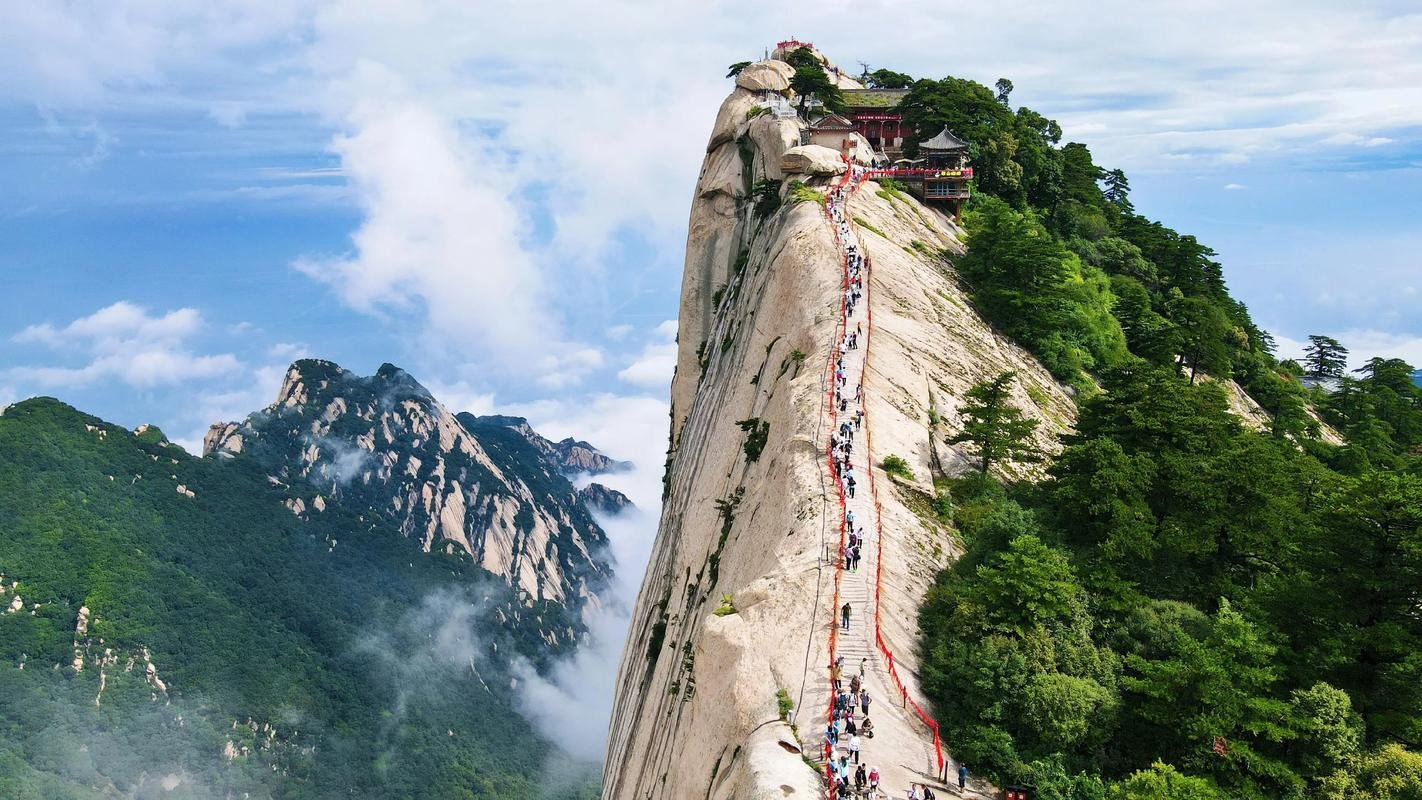
Geographic Location of West Yue Huashan
West Yue Huashan, one of China’s revered Five Great Mountains, is geographically situated in Huayin City, Weinan Prefecture, Shaanxi Province—northeast of Shaanxi Province in central China.
Perched at the eastern foot of the Qinling Mountains and flanking the southern bank of the Yellow River, the mountain lies approximately 120 kilometers east of Xi’an (Shaanxi’s provincial capital) and 15 kilometers south of downtown Huayin. It straddles the junction of the Qinling Mountains and the Loess Plateau, covering a total area of around 150 square kilometers, with its core scenic zone spanning 110°05′-110°17′ E longitude and 34°25′-34°36′ N latitude.
Huashan’s terrain is dominated by towering granite peaks, with its highest point being South Peak (Lotus Peak) at an elevation of 2,154.9 meters above sea level. The other three iconic peaks also boast impressive heights: East Peak (Sunrise Peak) at 2,096.2 meters, West Peak (Falling Goose Peak) at 2,082.6 meters, and North Peak (Cloud Terrace Peak) at 1,614 meters. Its proximity to key transportation hubs—including Huashan North High-Speed Railway Station (10 km away)—ensures convenient access for visitors seeking its dramatic landscapes.
The History, Legends, and Origins of West Yue Huashan
West Yue Huashan is not only a natural marvel but also a cultural landmark steeped in 2,000 years of Chinese history, mythology, and spiritual heritage. Its story weaves together imperial reverence, Taoist wisdom, and timeless legends that have shaped its status as one of China’s most sacred mountains.
Geological Origins
Huashan’s dramatic landscape traces back to over 100 million years ago, during the Cretaceous period. Formed by intense tectonic movements and the uplift of the Qinling Mountains, the mountain is composed of hard, coarse-grained granite. Centuries of erosion by wind and water carved its signature sheer cliffs, narrow ridges, and jagged peaks—creating the “most precipitous mountain under heaven” that we see today. Geologically, it sits at the boundary of the Qinling orogenic belt and the Loess Plateau, a unique setting that contributes to its striking terrain.Historical Evolution & Imperial Connections
The mountain’s human history dates back to the Western Zhou Dynasty (1046–771 BCE), when it was first revered as a sacred site. Its formal recognition as “West Yue”—one of China’s Five Great Mountains—came during the Qin Dynasty (221–207 BCE), as part of the imperial system of worshipping mountains to legitimize rule.- Han to Tang Dynasties: Emperors regularly sent envoys to Huashan to offer sacrifices to heaven and earth. During the Tang Dynasty (618–907 CE), Taoist temples flourished here, with emperors like Taizong and Xuanzong supporting the construction of abbeys, solidifying Huashan’s status as a Taoist sacred land.
- Song to Ming-Qing Dynasties: The mountain’s cultural significance deepened. Scholar-officials and poets visited to compose verses, leaving over 5,000 stone carvings that still adorn its cliffs. Ming Dynasty emperors further elevated its status, funding large-scale renovations of temples like Jade Spring Temple. By the Qing Dynasty (1644–1912), Huashan had become a major pilgrimage site, attracting devotees from across the country.
Taoist Heritage & Spiritual Roots
Huashan is one of the birthplaces of Taoism, China’s indigenous religion. Its spiritual legacy is tied to key Taoist figures and philosophies:- Zhang Daoling & Taoist Foundations: In the Eastern Han Dynasty (25–220 CE), Zhang Daoling—founder of organized Taoism—visited Huashan to cultivate virtue and practice meditation. The mountain’s isolated peaks and serene valleys made it an ideal retreat for Taoist masters seeking enlightenment.
- Quanzhen School: During the Jin Dynasty (1115–1234), Huashan became the headquarters of the Quanzhen School, a major Taoist sect. Jade Spring Temple at the mountain’s foot served as the sect’s ancestral home, nurturing renowned masters like Wang Chongyang and his disciples.
- Immortal Legends: Taoism’s influence gave rise to stories of immortals dwelling on Huashan. The most famous is the tale of Zhang Guolao, one of the Eight Immortals, who was said to have cultivated immortality here. His footprints are purportedly preserved on Guolao Ridge (Immortal Zhang’s Ridge), a narrow path on the mountain.
Timeless Legends & Cultural Tales
Huashan’s cliffs and peaks are etched with mythic stories that add romance and mystery to its allure:- Ax-Split Stone: A large boulder split cleanly in two is linked to a legend of a celestial being who split the rock to save a young couple trapped by a tyrant. The split symbolizes courage and liberation.
- Butterfly Lovers on West Peak: West Peak (Falling Goose Peak) is associated with the tragic romance of Liang Shanbo and Zhu Yingtai, China’s “Romeo and Juliet.” It’s said their spirits ascended to Huashan after their death, with the peak’s shape resembling a butterfly’s wings.
- Plank Road in the Sky’s Origin: The thrilling Plank Road is attributed to He Xiangu, another of the Eight Immortals, who carved the path into the cliff to meditate in seclusion. Later, Taoist monks expanded it to connect sacred sites.
- Imperial Oath of Liu Bang: During the Western Han Dynasty, Emperor Liu Bang is said to have sworn an oath on Huashan to unify China, cementing the mountain’s role as a symbol of unity and legitimacy.