Mount Hua Hiking Guide: Cable Cars, the Plank Walk and a Route That Works
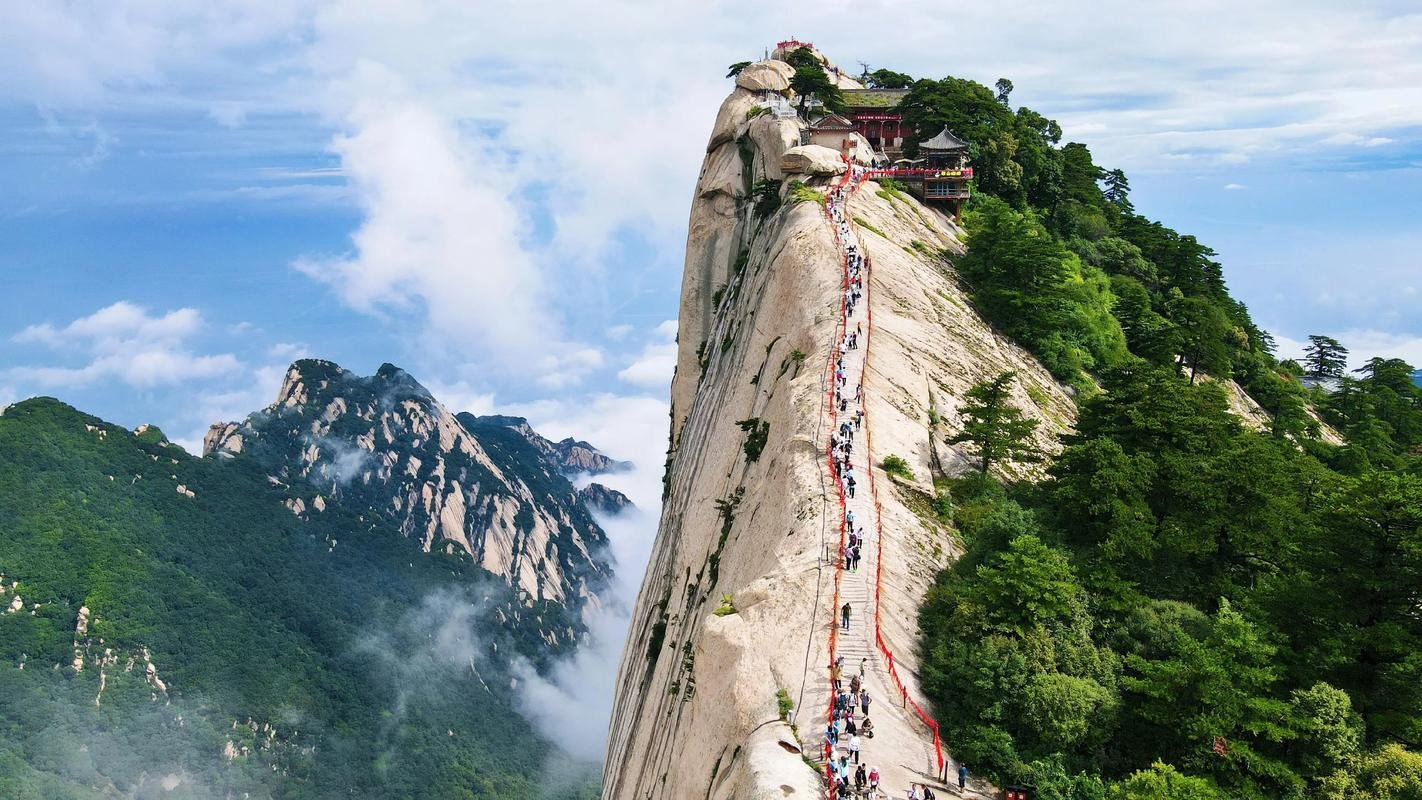
Mount Hua is the mountain that convinces visitors China has a taste for vertigo. The rock comes up in granite slabs, the steps are cut into the joints between them, and the paths linking the five peaks run along ridges that drop away on both sides. At 2,154 metres it is not the highest of the sacred mountains, but it is the steepest.
Its reputation is misleading. Much English-language material reduces Huashan to a stunt: the plank walk, the cliff ladders, the “world’s most dangerous hike”. In practice it is an efficiently run scenic area with two cable cars, English signs and serious weekend crowds. The real risk is queueing for two hours and then descending 7,000 steps on tired legs. This guide covers trains from Xi’an, which cable car to ride, ticket prices and an order that avoids both. If you want a wider menu of Chinese trails first, start with the best hiking trails in China.
Mount Hua at a glance
| Location | Huayin, Shaanxi Province, about 120 km east of Xi’an |
|---|---|
| Elevation | South Peak, 2,154 m |
| Transport | High-speed rail from Xi’an North, 30–40 minutes; about 2 hours by road from Xi’an Xianyang airport |
| Best months | April–June and September–November |
| Typical cost | about ¥500–650 per person for a day with cable cars |
| Time needed | One long day; two for sunrise |
Understand the layout before you buy a ticket
Huashan is not one summit with one path up it. It is a cluster of five peaks on a granite massif, and the two cable cars arrive at opposite ends of the cluster. That single fact decides your day.
- North Peak (1,614 m) — the lowest, where the historic footpath arrives and the North cable car lands.
- West Peak (2,038 m) — reached by the longer, newer West cable car; the ridge walk starts here.
- South Peak (2,154 m) — the highest point and the location of the plank walk.
- East Peak (2,091 m) — the sunrise viewpoint, with the chess pavilion below it.
- Central Peak (2,042 m) — a short detour between the East and West ridges.
The traverse from West to North, taking in the other three, is 5 to 7 hours of stairs. Ride up the West line and down the North line and you see the whole mountain once, without repeating a section. Ride up and down the same line and you either re-walk the ridge or miss half of it.
Getting there from Xi’an
By high-speed train
Huashan North station sits on the Zhengzhou–Xi’an high-speed line. Trains leave Xi’an North every 20 to 40 minutes, take 30 to 40 minutes and cost roughly ¥55–70 in second class. From the station, a taxi or local shuttle reaches the visitor centre in 15 minutes (about ¥15–25). Book with your passport on the 12306 app; the China high-speed rail guide explains the process.
Do not confuse it with the older Huashan station, which sits near Yuquan Temple and the start of the footpath — useful only for a conventional-train arrival before a night climb.
By bus, car or air
Coaches from Xi’an’s eastern bus station reach Huayin in about 2 hours and cost less than the train; driving takes 1.5 hours on the G30. From Xi’an Xianyang airport, take the shuttle or metro to Xi’an North and continue by rail.
Tickets and costs
These are typical 2025–2026 figures. Chinese ticket prices change with season and policy, so confirm on the official Huashan mini-program or at the ticket hall.
| Item | Approximate price | Notes |
|---|---|---|
| Admission, peak season (March–November) | about ¥160 | Valid 24 hours from first entry |
| Admission, winter (December–February) | about ¥100 | Some upper paths close after snow |
| West Peak cable car | about ¥140 one way | Longer ride, better views |
| North Peak cable car | about ¥80 one way | Closest to the old footpath |
| Shuttle buses to the cable car bases | about ¥40 and ¥20 | Compulsory; the roads are closed to walkers |
| Plank walk harness | about ¥30 | Optional, cash or mobile payment |
Foreign cards often fail in the mini-program; link one to Alipay or WeChat Pay before you travel and carry ¥200–300 in cash.
Four ways up, and which one to pick
1. West cable car up, North cable car down
This is the route for one day and average fitness. The West cable car climbs from the valley to near the West Peak in about 20 minutes, with a vertical rise that makes the glass floor panels feel optimistic. From the top station, walk to the West Peak (20 minutes), follow the ridge south to the South Peak (about an hour), take the plank walk if you want it, continue to the East and Central Peaks, and finish at the North Peak for the cable car down.
Start at the visitor centre by 8 am. The cable car queue at 10 am on a Saturday can be 90 minutes; at 8 am it is 15. Allow 5 to 7 hours on the mountain plus 2 hours for transport and tickets.
2. The traditional footpath from Yuquan Temple
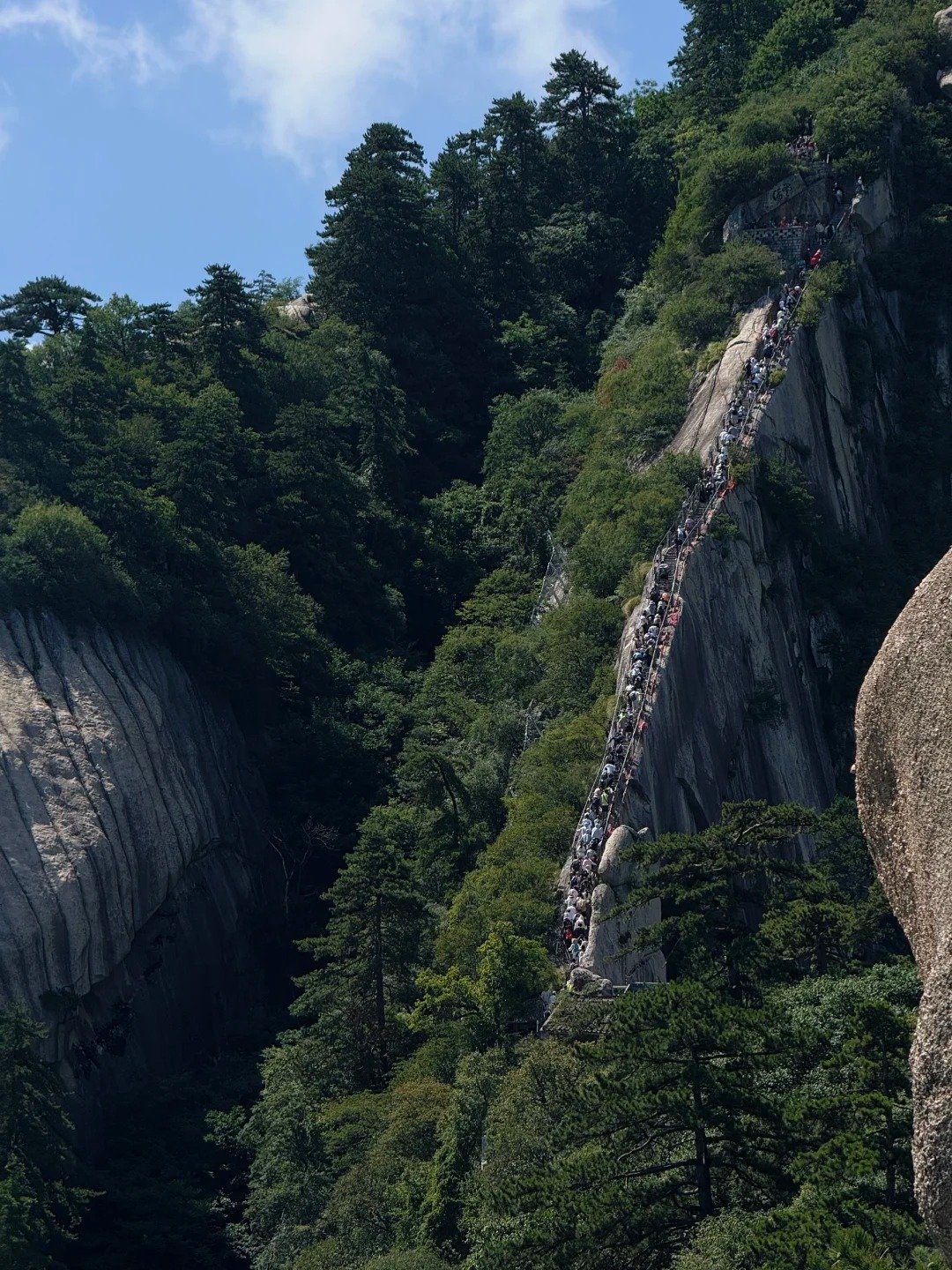
The old pilgrimage route starts at Yuquan Temple and climbs for 4 to 6 hours to the North Peak. It is genuinely hard: roughly 4,000 steps, with sections where the path narrows to a crevice and you haul yourself up on chains. The landmarks come in a useful order — the Turn-Back Stone (named for the pilgrims who decided they had seen enough), then the Thousand-Feet Tower and the Hundred-Feet Gorge, two near-vertical clefts that are the closest thing on the mountain to a ladder.
Worth doing with a full day and strong knees; not worth doing in rain.
3. Up and down the same cable car
If you are travelling with children, nursing an injury or short of time, use the West line both ways and walk only the West–South–East loop. You see the best scenery and skip the crowded North Peak junction.
4. The night climb
Chinese hikers often start from Yuquan Temple at 9 or 10 pm to reach the East Peak before dawn. The path is partly lit and stalls sell water most of the way, but you arrive cold and sleepless and then descend 4,000 steps. Sunrise falls between about 5:40 in June and 7:10 in December; bring a headlamp rather than relying on a phone.
The plank walk, without the hype
The Chang Kong Zhandao — usually translated as the plank walk — is a line of wooden boards pinned to a vertical cliff below the South Peak, about 30 cm wide, with a steel cable at chest height. You rent a harness at the entrance, clip on, and shuffle sideways above a drop of several hundred metres. It costs about ¥30 and takes 20 to 30 minutes including the queue.
Two things are worth knowing. It closes in rain, snow and high wind, and nobody guarantees it will be open on your day. And it is not required: the South Peak is reached by ordinary stone steps, and the plank walk is a loop that returns to the same place. If you are unsure, walk to the entrance, look at the first ten metres and decide there.
Where to sleep
Huayin town, near the visitor centre, is the practical base: cheap hotels, early restaurants and a 10-minute ride to the gate.
On the summit, a handful of basic hotels serve sunrise chasers, the East Peak hotel being the obvious one. Rooms are small, bathrooms shared, bedding thin, and the weekend price is not a typing error.
Xi’an works if you leave at 6:30 am; the train is fast enough that a day trip is genuinely comfortable.
When to go
| Season | What you get | Caveats |
|---|---|---|
| April–June | Dry steps, green slopes, long days | May Day holiday is packed |
| July–August | Storm clouds and dramatic light | Humidity, crowds, afternoon thunderstorms |
| September–November | Clearest air, autumn colour | Weekends busy; cold on top after October |
| December–February | Snow on the granite, no queues | Ice, closed paths, cable cars stop in wind |
Late October is the sweet spot: summer haze has cleared, the ridge is gold and red, and the summit is cold rather than hostile. Bring gloves — the chains are metal.
Practical notes
- Start early. The mountain runs on a first-come basis and the cable car queue is the whole game.
- Pack layers, not luggage. The summit is 8–10°C colder than Huayin; see this mountain hiking packing list.
- Carry water and salt. Cramps on the descent are the most common problem; stalls charge summit prices.
- Knees: descending 7,000 steps is harder than climbing them. Poles help and the cable car is not cheating.
- Crowds: avoid the first week of October, Lunar New Year and weekends. A Tuesday in November feels like a different mountain.
Where to go next
If Huashan is one stop on a longer trip, these help you plan around it: photographs and background on Huashan and Huayin, the Mount Tai guide for the easier, more historic sacred climb, Huangshan for granite peaks without the staircases, and the ten most beautiful mountains in China.
Frequently asked questions
How long does it take to climb Mount Hua?
A one-day visit using both cable cars takes 7 to 9 hours door to door, of which 5 to 7 hours are spent on the mountain. The full footpath from Yuquan Temple to the North Peak takes 4 to 6 hours of hard stair climbing, and a night climb for sunrise needs 6 to 7 hours in the dark.
Is the Mount Hua plank walk dangerous?
It is safer than the videos suggest but not a walk in the park. You clip into a fixed cable with a hired harness, the boards are roughly 30 cm wide, and the exposure below is several hundred metres. It costs about ¥30, closes in rain, snow or high wind, and is entirely optional — the South Peak can be reached without it.
Should I take the West or North Peak cable car?
Take the West Peak cable car up and the North Peak cable car down if you want the full ridge traverse without exhausting yourself. The West line is longer and more scenic but drops you at the far end of the mountain; the North line is shorter and puts you closest to the old footpath and the train station.
How much does a day on Mount Hua cost?
About ¥500–650 per person including admission (about ¥160 in peak season), one cable car up and one down (about ¥140 and ¥80), the two shuttle buses (about ¥40 and ¥20), and lunch. Prices change, so confirm at the ticket office or the official Huashan mini-program before you travel.
Can you see Mount Hua as a day trip from Xi’an?
Yes, and most people do. High-speed trains from Xi’an North take about 30 to 40 minutes to Huashan North, and the station is 15 minutes from the visitor centre. Leave Xi’an before 7 am, start up by 9 am, and you can be back in the city for dinner.
When is the best time to climb Mount Hua?
April to June and September to November, when the stone steps are dry and the air is clear. July and August are hot and crowded, winter is beautiful but the upper paths ice over, and the first week of October is the busiest period of the year.
Keep reading
Hiking & Trekking
Wugongshan: The Two-Day Grass Plateau Hike in Jiangxi
Most Chinese mountains are about rock and temples. Wugongshan is about grass. Above roughly 1,600 m the trees …
Hiking & Trekking
Yubeng Village Trek: Four Days Below the Meili Snow Mountains
Yubeng is a Tibetan village of about forty households sitting at 3,100 m under the Meili Snow Mountains, and …
Hiking & Trekking
How Hard Is Gongga Trekking? Altitude, Day Lengths and Honest Comparisons
Gongga has a reputation in China that travel brochures rarely explain. People say it is wild, unpredictable …