Mount Fanjing Travel Guide: Mushroom Rock and the Sky Island
Fanjingshan is a sky island: an isolated massif of old metamorphic rock pushed up out of the Wuling range, cut off from similar habitats for long enough that evolution went its own way. It rises to about 2,570 metres, holds species that exist nowhere else, and carries a Buddhist pilgrimage site on a pinnacle split by a fissure. UNESCO listed it as a natural World Heritage site in 2018, on the strength of the ecology rather than the temples.
It is also not a casual stop. Tongren is the nearest city and it is not on the standard foreign-tourist circuit, entry numbers are capped, and the last section is a queue on a staircase bolted to a rock. What you get for that effort is one of the strangest landscapes in southern China — moss forest, cloud, and two tiny temples joined by a stone bridge above a drop. This guide explains the logistics, the booking trap, the route, and what the weather will probably do to your plans.
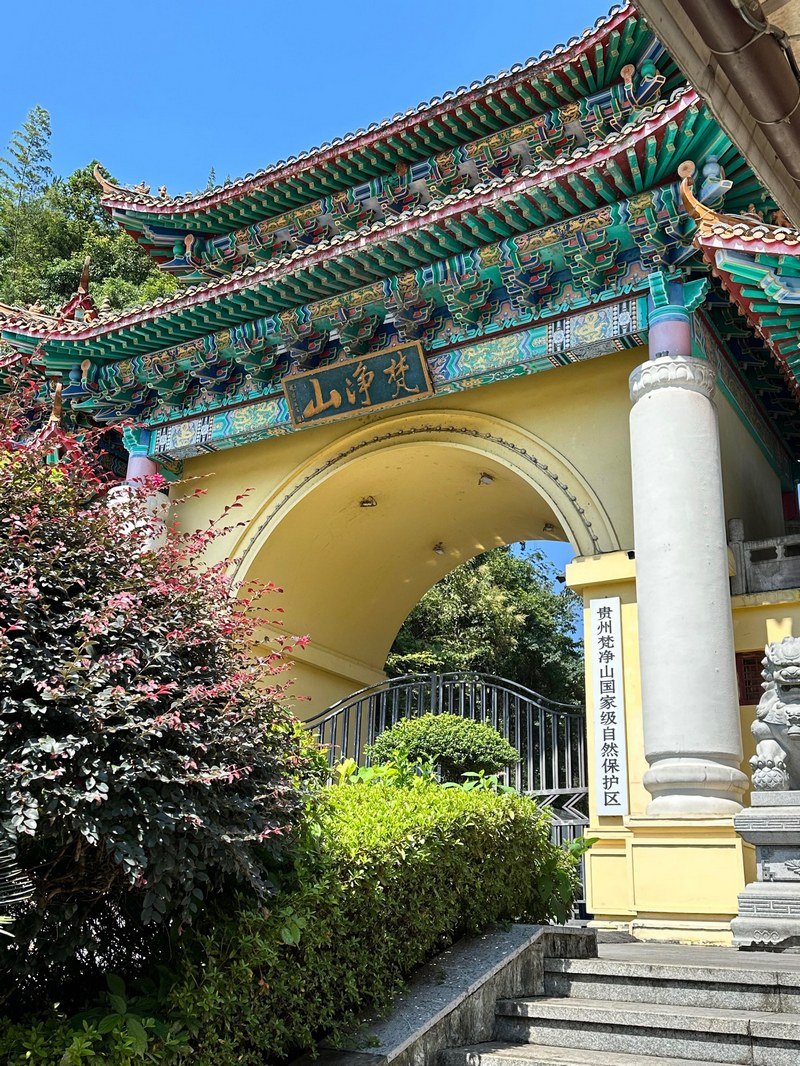
Fanjingshan at a glance
| Location | Tongren, northeastern Guizhou, near the Hunan border |
|---|---|
| Nearest rail | Tongren South on the Shanghai–Kunming high-speed line, then 1.5 hours by road |
| Admission | About ¥110 plus a shuttle fee; cable car extra |
| Cable car | One line from the Jiangkou side, about ¥160 return |
| Days needed | 1 long day, 2 if you want a weather backup |
| Best months | May to June and September to October |
Getting to Tongren, then to the gate
Tongren has two useful arrival points. Tongren South sits on the Shanghai–Kunming high-speed line and takes direct trains from Shanghai, Hangzhou, Changsha and Kunming, with the Guiyang connection being the quickest from the west; the ticketing works the same way as everywhere else, as our high-speed rail guide explains. Tongren Fenghuang airport handles domestic flights and is named after the nearby Fenghuang ancient town, which is worth a night on the way in or out. Either way, the road to the mountain takes roughly 1.5 hours.
The main tourist entrance is at Jiangkou, east of the massif, where the visitor centre, car park, hotels and cable-car station sit together. A second, western approach from Yinjiang exists for walkers and is much longer, with fewer facilities and inconsistent access; do not plan around it without checking locally. From Jiangkou, a shuttle bus runs to the cable-car base, and the cable car climbs most of the vertical gain in about fifteen to twenty minutes.
The road journey is the easy part. The booking is not. The reserve limits daily visitor numbers and issues timed entry slots, and the official booking channel is a WeChat mini-program that frequently fails for foreign passports. Tickets are released in advance and disappear in summer. Your hotel in Tongren or Jiangkou can usually book with a passport photo and a phone number, and a local guide is the other reliable option. Turning up at the gate hoping for a ticket is a waste of a day.
Why the mountain looks like this
Most of Guizhou is limestone karst: soft rock dissolved into towers, caves and sinkholes. Fanjingshan is the opposite. Its core is old marine sediment that was compressed, folded and metamorphosed into hard schist and quartzite, then lifted as a block while the land around it eroded away. The result is sharp ridges, thin soil, and cliffs that stand rather than crumble. The granite pillars of Mount Huangshan read as cousins in a photograph, but they were formed by a different process entirely.
The shapes follow from that. Mushroom Rock is a balanced boulder sitting on a narrower stem, the product of differential weathering — the upper block is harder than the rock beneath it, so the base wore away first. The Red Cloud Golden Summit is a single pinnacle split almost vertically, with a temple on each half and a small stone bridge between them. The split is a joint in the rock widened by freeze and thaw; the temples were built because the place looked impossible, which is roughly how most sacred mountains acquire their architecture.
Above the cable car, the path runs through a forest of dwarf bamboo, moss-covered trunks and old firs, with the canopy low and the light green. This is not the postcard China of pavilions and lakes. It is wet, quiet and slightly gloomy, and it is the reason the reserve exists.
Wildlife, and why the forest is protected
Fanjingshan is the only home of the Guizhou golden monkey, a grey snub-nosed primate that lives in troops at altitude and is one of the rarest monkeys in the world. The reserve also holds the Fanjingshan fir, a conifer restricted to a few ridges, and the dove tree, a species that survived the ice ages in southern China and is planted worldwide as an ornamental. Thousands of plant species are recorded, a large number of them medicinal.
You will not see the monkey. They are shy, few, and live away from the tourist paths. What you will see is the forest structure that supports them, which is the point of a natural World Heritage listing: the value is the ecosystem, not the view.
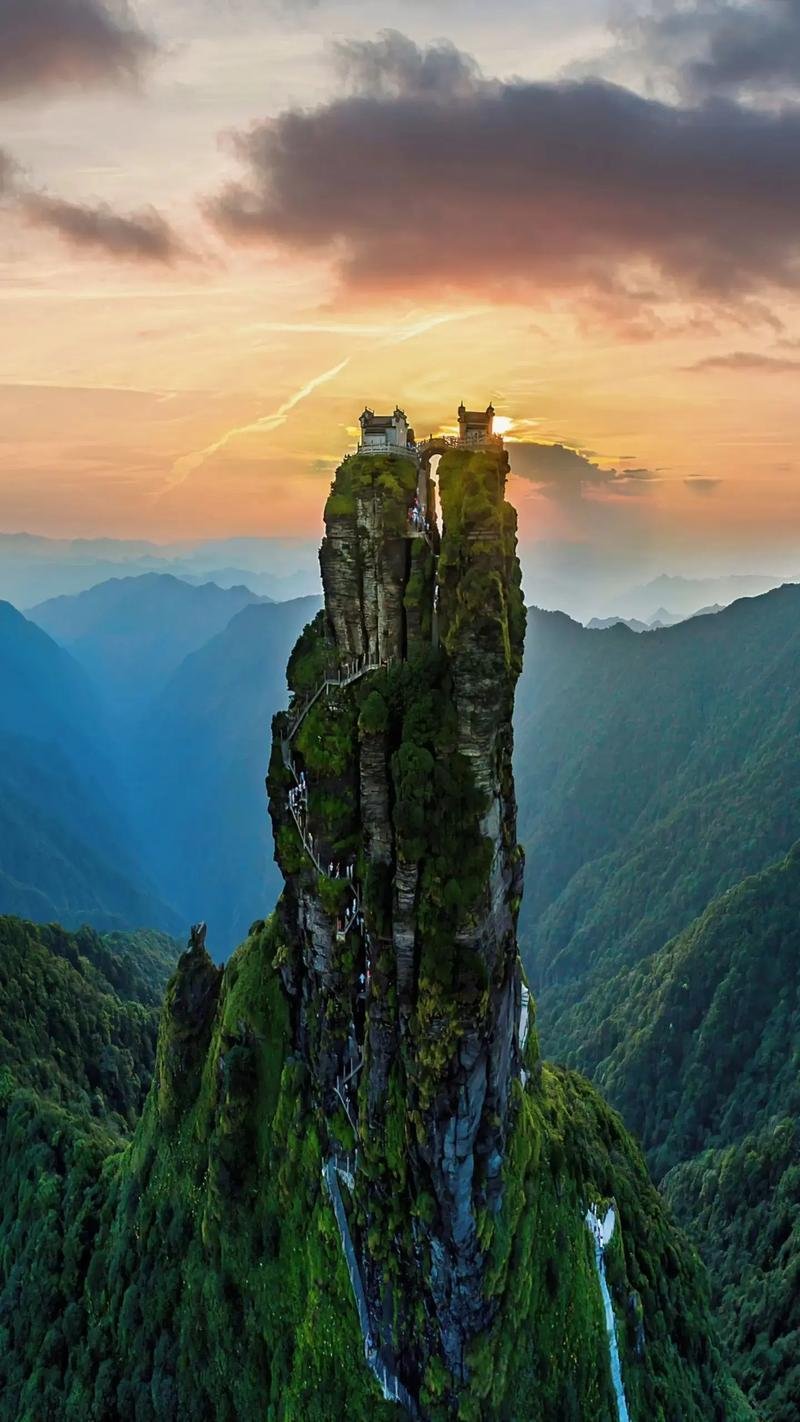
The walk: cable car, boardwalk, and the summit stairs
Almost everyone follows the same route. Shuttle from Jiangkou to the cable-car base, cable car to the upper station, then a loop of boardwalks and stone steps that visits Mushroom Rock, the viewpoints, and the base of the Golden Summit. The loop itself takes two to three hours at a normal pace, with plenty of places to stop.
The summit is the bottleneck. A single narrow staircase, cut into the pinnacle and equipped with chains, climbs to the saddle between the two temples. It is one-way in busy periods, and the wait at the bottom can be 30 minutes in summer and much longer on a holiday. The climb is only 30 to 40 minutes, but it is steep, exposed, and not somewhere to carry a large bag.
The traditional full ascent from the valley is counted at 8,888 steps. Very few people do it now that the cable car exists, and the upper section is the same either way. If you are reasonably fit and want the forest, walking up is a serious half-day and the path is well made; if you are here for the geology and the temples, the cable car is not cheating.
One day or two
One long day: leave Tongren before dawn, reach Jiangkou for the first entry slot, cable car up, walk the loop, queue for the summit, and be back in Tongren by evening. It works if the weather cooperates and the queues do not. It is also exhausting and leaves no margin.
Two days, which I would choose: sleep in Jiangkou the night before, take an early slot, and treat day one as the mountain. If cloud closes everything, you still have day two. The town is basic but cheap, with guesthouses within walking distance of the gate and a handful of restaurants serving Guizhou food — sour fish soup, smoked pork, rice noodles — that is better than the snack stalls on the mountain.
A third day lets you add Fenghuang, the riverside town an hour or so away, or the villages of the Miao and Tujia minorities that give this corner of Guizhou its character. Neither is a mountain, but both make the journey across the province feel less like a single-objective trip.
Costs, weather and the honest downside
Entry is about ¥110, with a shuttle fee of roughly ¥20 and a cable car around ¥160 return. Prices move; check at booking. The reserve closes paths in ice and heavy snow, and the cable car stops in high wind. Fog is the constant: Fanjingshan sits in a wet climate and cloud can sit on the ridge for days, so check the best time to visit China and then check the local forecast again. The sea of clouds in every photograph is a weather event, not a feature.
The honest downside is that the summit experience is short and shared with a lot of people, and the infrastructure — queuing pens, loudspeakers, handrails — is emphatically Chinese mass tourism. The compensation is that the forest on either side of the summit is genuinely wild, and the reserve is one of the few places in the country where the conservation is not marketing. Go on a weekday, book early, and give the weather a second chance.
Where to go next
Fanjingshan fits into a southwest China loop. Zhagana, far to the northwest in Gansu, is the other Chinese mountain landscape that feels like another country. Mount Sanqing offers granite pillars and cliff walkways instead of forest and cloud, while Tianmen Mountain in Hunan shows what happens when a mountain is engineered for tourists.
For a broader shortlist, see the best national parks in China and the ten most beautiful mountains, both of which weigh scenery against the effort of getting there.
Frequently asked questions
Where is Mount Fanjing and how do I get there?
Fanjingshan rises in Tongren, northeastern Guizhou, close to the Hunan border. The usual route is a high-speed train to Tongren South on the Shanghai–Kunming line, then a bus or car of about 1.5 hours to the Jiangkou gate. Tongren Fenghuang airport is a similar distance by road.
Do I need to book entry in advance?
Yes, and this is the part most foreign visitors get wrong. The reserve caps daily numbers and uses timed slots, with tickets released online ahead of the visit. In summer and around holidays they sell out. Ask your hotel or a local agent to book with your passport, because the WeChat booking system often rejects foreign identity details.
How long does the climb to the Golden Summit take?
From the upper cable-car station, the boardwalk loop takes two to three hours including stops. The final staircase up the Red Cloud Golden Summit is narrow, one-way in places, and takes about 30 to 40 minutes with queues. The full walk from the valley, traditionally counted at 8,888 steps, is a half-day ascent.
Is Mushroom Rock easy to reach?
Yes. It stands beside the main boardwalk on the summit circuit, a few minutes from the path, and needs no climbing. It is one of the busiest photo stops on the mountain, so pass it early in the morning or late in the afternoon when the tour groups have moved on.
Is Fanjingshan worth the effort?
If you care about forests, weather and strange rock, yes. It is a genuine biological reserve with species found nowhere else, and the twin temples on the split pinnacle are unlike anything else in China. If you want guaranteed views and easy access, the cloud often wins and you will see very little.
What is the best time to visit Fanjingshan?
May and June for rhododendrons and green forest, and September to October for the clearest skies. July and August are warm but crowded, and winter brings ice that closes the summit stairs. Fog is possible in any month, so build in a spare day if the mountain is the purpose of your trip.
Keep reading
Nature & Parks
National Parks in China: What the Designations Actually Mean
Two systems, and why the confusion matters Search for "national parks in China" and you will get a list that …
Nature & Parks
Kanas Lake: Hemu, Baihaba and the Autumn Window in Xinjiang
Kanas is a long, cold lake at about 1,370 m in the far north of Xinjiang, roughly 24 km from end to end and …
Nature & Parks
15 Natural Wonders in China: Karst, Desert, Lakes
The honest answer to "what should I see in China" is not a list of cities. It is a set of landscapes that do …