Tianchi Lake at Changbai Mountain: When the Crater Lake Appears
Tianchi — Heaven Lake — is the reason people fly to Changbai Mountain: a crater lake at about 2,190 m inside a volcanic caldera, roughly 10 square kilometres of water and 373 m deep at its lowest point, with the far shore in North Korea. The caldera was left by one of the largest eruptions of the last two thousand years, usually dated to around 946 CE, and the lake that filled it now feeds the Erdaobaihe, the headwater of the Songhua. It is the deepest lake in China and not a place you can walk to.
The other thing to understand is that seeing it is a lottery. Cloud sits over the rim for much of the year, and the visit itself is a chain of buses, a stair climb and a railed platform shared with several hundred other people. This guide is about improving the odds — which slope, which month, which hour — and leaves transport, ticket prices and the rest of the mountain to the full Changbai Mountain guide.
Tianchi at a glance
| Location | Southeast Jilin, Antu County, Yanbian Korean Autonomous Prefecture; the lake straddles the North Korean border |
|---|---|
| Nearest airport | Changbaishan Airport, about an hour from Erdaobaihe; Yanji Chaoyangchuan is farther but better connected |
| Altitude | Lake surface about 2,190 m; the viewing platform sits a few hundred metres above the water |
| Best months | Late September to early October; July and August for warmth and an ice-free lake |
| Days needed | Two nights in Erdaobaihe for two attempts; three if you add a second slope |
| Tickets | About ¥105 admission, about ¥85 mandatory shuttle and about ¥80 for the rim vehicle on the north slope; passport checked at the gate |
The lake inside the caldera
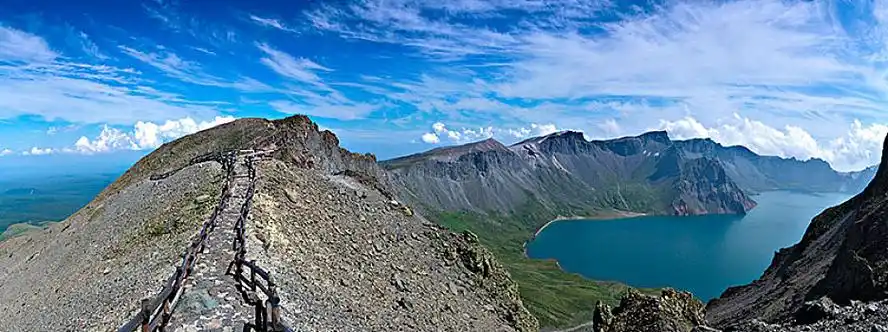
The water is about 373 m deep, the surface is at about 2,190 m, and the rim around it rises from roughly 2,500 m to Baiyun Peak at 2,691 m. Baiyun is closed to visitors, so the highest point you will reach is the viewing platform, not a summit. There is no trail around the shore, no beach and no boat.
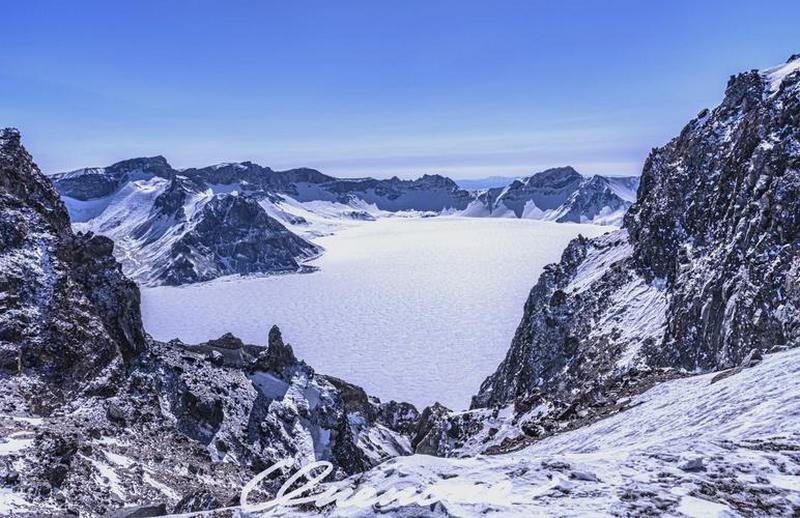
Because of the latitude and the height, the lake is frozen for most of the year. Ice typically forms in late autumn, sits more than a metre thick through winter, and does not clear until late June or July; in early summer you can still find slabs pressed against the shore. The reliable ice-free window is July into September. The far side of the water is North Korea, marked by a line out in the lake, and the north-slope platform is a fenced deck looking down into the bowl rather than a shoreline you can approach.
On a good day you see grey and ochre cliffs dropping into water that shifts from turquoise at the edges to near-black in the middle. Photographs flatten it; the scale only lands when you notice how small the buses look on the road below.
Why the lake hides
The caldera is a bowl that catches cloud. Moist air pushed up the outer slopes condenses as it rises, and by mid-morning the rim is often inside a whiteout while Erdaobaihe below is sunny. Locals say the mountain has its own weather, and they are not being poetic: the rim is routinely 10 to 15 degrees colder than the base, with wind that makes the difference feel larger.
The practical consequences are simple. Take the first shuttle up, because the clearest window is usually before ten o'clock. If the rim is solid white, do not stand on the platform hoping; ride down, see the waterfall and the hot springs, and ask at the ticket office whether a second ascent is possible on the same vehicle ticket before you assume it is. If you have a spare morning, use it. Two attempts is the single biggest improvement you can make to your odds, and it matters more than choosing the perfect week.
Forecasts for the base town are close to useless for the rim: a grey morning in Erdaobaihe can sit under a clear caldera. Treat any prediction as a hint, not a plan.
North, west and south: choosing a slope
North slope, from Erdaobaihe. This is the classic visit and the one to book if you have a single day: a shuttle from the gate, a smaller vehicle for the last stretch to the rim, then stairs to the platform. On the way down, the Changbai waterfall, the Julong hot springs and the underground forest are separate stops on the same bus loop. It is also the busiest, and the rim vehicle runs on capacity, so the queue forms before opening. Erdaobaihe is 30 to 40 minutes from the gate and has the best range of hotels and Korean-Chinese restaurants.
West slope, from Songjianghe. The west gate leads to the Grand Canyon, the alpine garden and a long staircase of about 1,400 steps to the rim. There are fewer tour groups and more actual walking, and the autumn colour here beats the north side. The catch is that the climb is tiring at this altitude, the stairs are exposed, and the rim can be shut without warning. Allow a full day and a car.
South slope, from Changbai county town. The quietest and least developed of the three, looking over the Yalu River gorge and the Fifteen Ditch valley. It is the farthest from any airport, the lake access is seasonal, and the view is the least dependable. Choose it if you have already seen the water and want the border landscape instead.
Do not plan to do two slopes in one day. The gates are two hours or more apart by road, tickets are slope-specific, and the shuttle systems do not connect. Buying a north-slope ticket does not get you through the west gate.
When to go for a clear view
| Period | What you get | Reality |
|---|---|---|
| May | Few visitors, thawing lake, snow on the rim | Low odds; parts of the rim still closed |
| June | Wildflowers starting, long days | Ice can still float on the lake; cold wind |
| July–August | Warmest, ice-free water, green meadow | Peak domestic season; cloud builds by late morning |
| Late September | Clear air, first birch and larch colour | The best balance of weather and crowds |
| Early October | Full autumn colour | Extremely busy from 1 to 7 October |
| Mid-October to April | Frozen lake, snow, ski season | Rim road often shut; severe cold |
The honest ranking is late September first, then the first half of October once the national holiday ends, then July and August. Winter is worth it only if you are coming for the ski resort or the snow scenery rather than the lake. Spring is cheap and quiet, but you are paying for a view you may not get.
Time of day matters as much as month. The first two hours after opening are the best window; by early afternoon the caldera is usually full. If you can only manage one visit, make it a morning in late September and accept that the mountain still decides.
Tickets, transport and where to sleep
By air. Changbaishan Airport is about an hour from Erdaobaihe, with seasonal flights from major cities; Yanji Chaoyangchuan is farther but better connected.
By rail. High-speed services reach the area via Shenyang and Changchun, with the last leg by bus or taxi. Allow more time than the ticket suggests, because the station is not at the gate; the China high-speed rail guide covers booking.
Tickets. On the north slope, budget about ¥270 per person for admission, shuttle and the rim vehicle. The rim vehicle is a separate charge, and prices change with season, so confirm at the gate. Your passport is checked at the gate, on the shuttle and at hotel check-in; if you still need one, start with the China visa guide for tourists.
Where to sleep. Erdaobaihe for the north slope, Songjianghe for the west, Changbai county town for the south. Rooms in Erdaobaihe run about ¥300–800 and book out in July, August and the first week of October. Pack for two climates; the mountain packing list covers the rest, and no drones belong in a border area.
Where to go next
For other high-altitude water, Kanas Lake in Xinjiang and Yulong Snow Mountain in Yunnan are the closest comparisons, though neither sits on a border. 15 natural wonders in China and the most beautiful mountains in China will help you sequence the rest of a trip, and the best national parks covers the reserves that work like this one.
Frequently asked questions
How likely am I to see Tianchi clearly?
It is close to a coin toss. Cloud covers the rim for much of the year, and on a wet July day you may see nothing but white. Two mornings on the north slope gives you a far better chance than any forecast.
Which month gives the best chance of a clear view?
Late September to early October. The lake is still ice-free, the summer haze has gone, and the crowds thin after the first week of October. July and August are warm, but cloud often builds by late morning.
Which slope should I choose for the lake?
The north slope from Erdaobaihe is easiest and fullest: bus, then a smaller vehicle, then stairs to the rim. The west slope means about 1,400 steps but fewer people. The south is quietest, and its lake view is the least reliable of the three.
Can you walk around Tianchi or swim in it?
No. The rim is fenced, the water is off limits, and the far shore is North Korea. You look from a platform, and the border line in the water is not a photo opportunity. Do not cross it or fly a drone.
How many days do you need for Tianchi?
Two nights in Erdaobaihe, which gives you two mornings and a spare afternoon for the waterfall and hot springs. Add a night if you also want the west slope or the Yalu River side.
Is Changbai still worth visiting if the lake is hidden?
Yes, though it changes the trip. The waterfall, hot springs, underground forest and border landscape fill a day, and the cloud itself is part of the mountain. Just do not plan the whole journey around one view.
Keep reading
Mountains
Hidden Mountains in China: 10 Peaks That Western Itineraries Skip
The mountains foreign visitors skip are not secret. Chinese hikers know them, photograph them and queue for …
Mountains
Mount Tai: Choosing a Route, Catching Sunrise and Sleeping on Top
Mount Tai rises 1,545 metres above the Shandong plain, a modest figure that has never been the point. What …
Mountains
10 Most Beautiful Mountains in China, Ranked
If you have time for exactly one mountain in China, make it Huangshan. If you have two weeks, the ten below …